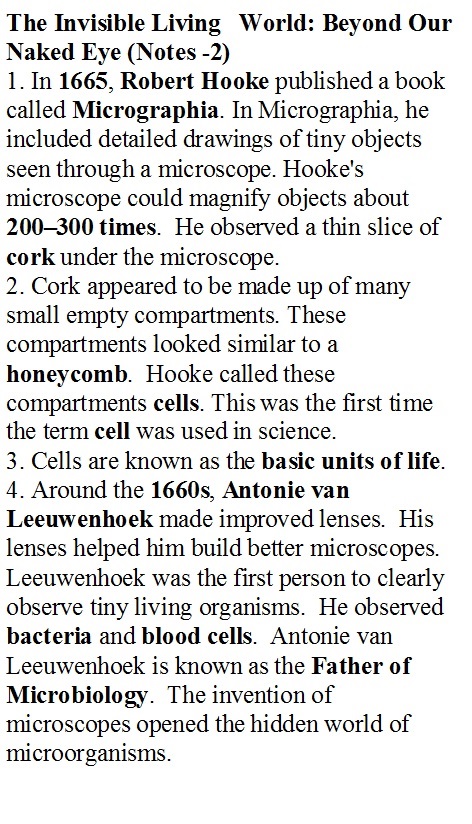
Short QAs Answer Sheet
1. Who published the book Micrographia?
2. In which year was Micrographia published?
3. What instrument did Robert Hooke use to observe tiny objects?
4. How much could Hooke's microscope magnify objects?
5. What material did Robert Hooke observe under the microscope?
6. What did Hooke call the small compartments seen in cork?
7. Why did Hooke name them "cells"?
8. Who made better lenses and more useful microscopes in the 1660s?
9. What tiny living organisms did Leeuwenhoek observe?
10. Why is Antonie van Leeuwenhoek called the Father of Microbiology?
Fill in the blanks
1. In __________, Robert Hooke published the book Micrographia.
2. Robert Hooke observed tiny objects using a __________.
3. Hooke examined a thin slice of __________.
4. The small compartments seen by Hooke reminded him of a __________.
5. Hooke named the small compartments __________.
6. The cell is the basic unit of __________.
7. Antonie van Leeuwenhoek was a __________ scientist.
8. Leeuwenhoek made better __________ for microscopes.
9. Leeuwenhoek was the first person to clearly observe __________.
10. Antonie van Leeuwenhoek is known as the Father of __________.
MCQs
1. Who published the book Micrographia?
A) Antonie van Leeuwenhoek
B) Robert Hooke
C) Louis Pasteur
D) Isaac Newton
2. In which year was Micrographia published?
A) 1660
B) 1665
C) 1675
D) 1680
3. Robert Hooke observed a thin slice of ________.
A) Leaf
B) Onion
C) Cork
D) Wood
4. Hooke's microscope could magnify objects about ________.
A) 20–30 times
B) 50–100 times
C) 200–300 times
D) 500–600 times
5. The small compartments seen by Hooke resembled a ________.
A) Spider web
B) Honeycomb
C) Nest
D) Leaf
6. What name did Hooke give to the small compartments he observed?
A) Tissues
B) Atoms
C) Cells
D) Nuclei
7. Who made better lenses and more useful microscopes in the 1660s?
A) Robert Hooke
B) Galileo
C) Antonie van Leeuwenhoek
D) Pasteur
8. Antonie van Leeuwenhoek was a ________ scientist.
A) English
B) French
C) German
D) Dutch
9. Which tiny organisms were first clearly observed by Leeuwenhoek?
A) Fungi
B) Algae
C) Bacteria
D) Mosses
10. Antonie van Leeuwenhoek is known as the Father of ________.
A) Botany
B) Zoology
C) Microbiology
D) Genetics
Help Line ‐