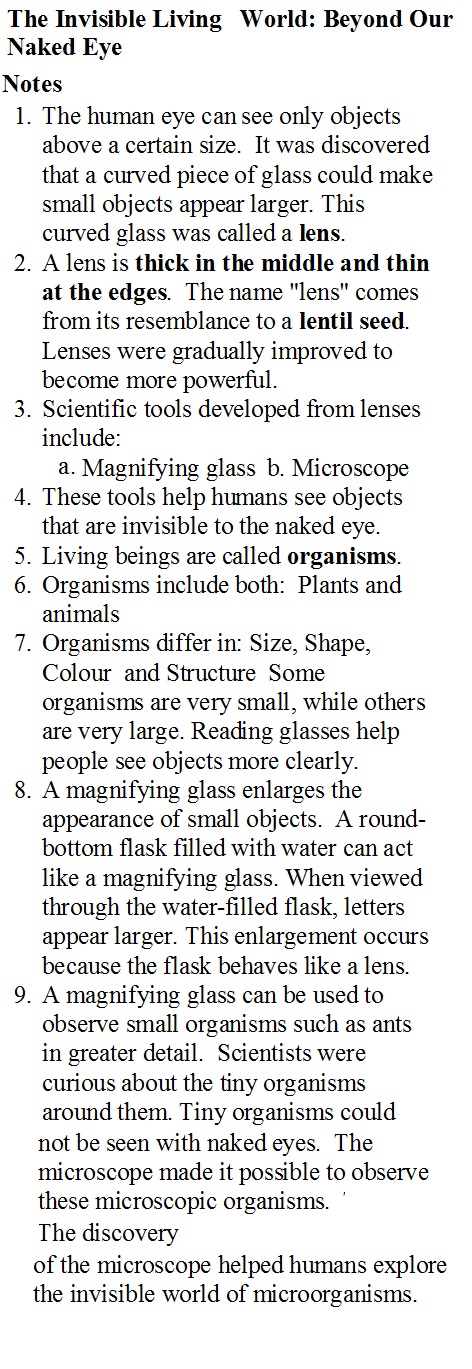
Short QAs Answer Sheet
1. What is a lens?
2. Why is it called a lens?
3. What is the shape of a lens?
4. What does a magnifying glass do?
5. What is a microscope?
6. What are living beings called?
7. Give two examples of organisms.
8. How do reading glasses help people?
9. What happens when letters are viewed through a water-filled flask?
10. Which invention helped humans discover microorganisms?
Fill in the blanks
1. A curved piece of glass that makes objects appear larger is called a __________.
2. A lens is thick in the __________ and thin at the edges.
3. A __________ helps us see very tiny objects.
4. All living beings are called __________.
5. A water-filled round-bottom flask acts like a __________ glass.
MCQs
1. The human eye can see only objects above a certain ________.
A) Colour
B) Shape
C) Size
D) Weight
2. Very tiny objects cannot be seen with the ________.
A) Microscope
B) Telescope
C) Naked eye
D) Lens
3. A curved piece of glass that makes objects appear larger is called a ________.
A) Mirror
B) Lens
C) Prism
D) Screen
4. A lens is thick in the ________ and thin at the edges.
A) Corner
B) Surface
C) Middle
D) Bottom
5. The word "lens" comes from its resemblance to a ________.
A) Pea
B) Bean
C) Lentil seed
D) Rice grain
6. Which instrument uses a lens to enlarge small objects?
A) Microscope
B) Magnifying glass
C) Thermometer
D) Barometer
7. Which instrument is used to see tiny organisms?
A) Compass
B) Telescope
C) Microscope
D) Weighing balance
8. All living things are called ________.
A) Tissues
B) Cells
C) Organisms
D) Organs
9. A water-filled round-bottom flask acts like a ________.
A) Magnet
B) Microscope
C) Magnifying glass
D) Thermometer
10. The invention that helped humans discover microorganisms was the ________.
A) Telescope
B) Microscope
C) Camera
D) Compass
Help Line ‐