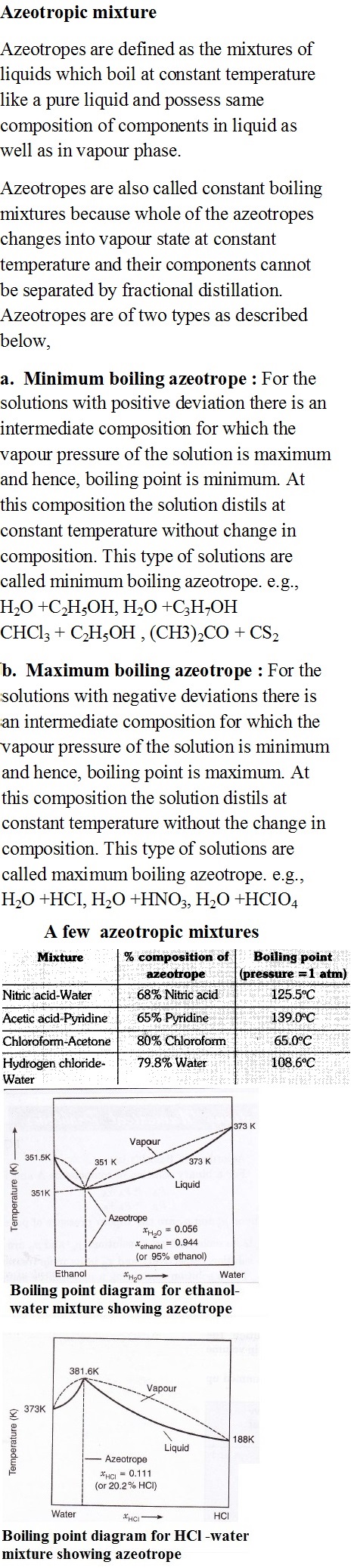
A few Boiling points
Water H2O 100°C Liquid
Hydrogen chloride HCl ‐85° C Gas
Nitric acid HNO3 83°C Liquid
Perchloric acid HClO4 ≈203° C (decomposes) Liquid
Methanol CH3OH 64.7° C Liquid
Ethanol C2H5OH 78.3° C Liquid
Propanol C3H7OH ≈97° C Liquid
Hydrogen chloride gas (HCl) ‐ 85°C (188 K)
Hydrochloric acid solution (≈20‐22% HCl in water, azeotrope)≈110 ° C
The boiling point of nitrogen dioxide (NO2) is about:
21°C (294 K) at 1 atm pressure.
Important note
In reality, NO2 dimerizes to form dinitrogen tetroxide (N2O4) at lower temperatures.
The liquid that boils at ≈21 °C is mainly N2O4, which is in equilibrium with NO2.
MCQs
1. Azeotropes are defined as mixtures that:
A. Boil at different temperatures
B. Boil at constant temperature like pure liquids
C. Do not vaporize
D. Have different compositions in vapour and liquid
2. Azeotropic mixtures are also called:
A. Ideal mixtures
B. Constant boiling mixtures
C. Dilute mixtures
D. Electrolytic mixtures
3. In an azeotropic mixture, the composition of vapour phase is:
A. Different from liquid phase
B. Same as liquid phase
C. Always zero
D. Twice that of liquid phase
4. Which of the following is an example of maximum boiling azeotrope?
A. Water + ethanol
B. Acetone + CS2
C. Water + HCl
D. Chloroform + ethanol
5. Minimum boiling azeotropes are formed by solutions showing:
A. Ideal behaviour
B. Positive deviation from Raoult's law
C. Negative deviation from Raoult's law
D. No vapour pressure
6. In minimum boiling azeotropes, the vapour pressure is:
A. Minimum
B. Zero
C. Maximum
D. Constant but low
7. Maximum boiling azeotropes are formed by solutions showing:
A. Positive deviation from Raoult's law
B. Negative deviation from Raoult's law
C. Ideal behaviour
D. No intermolecular forces
8. In maximum boiling azeotropes, the boiling point is:
A. Minimum
B. Maximum
C. Equal to solvent
D. Zero
9. Which of the following is an example of minimum boiling azeotrope?
A. Water + HCl
B. Water + ethanol
C. Water + nitric acid
D. Water + perchloric acid