MCQs
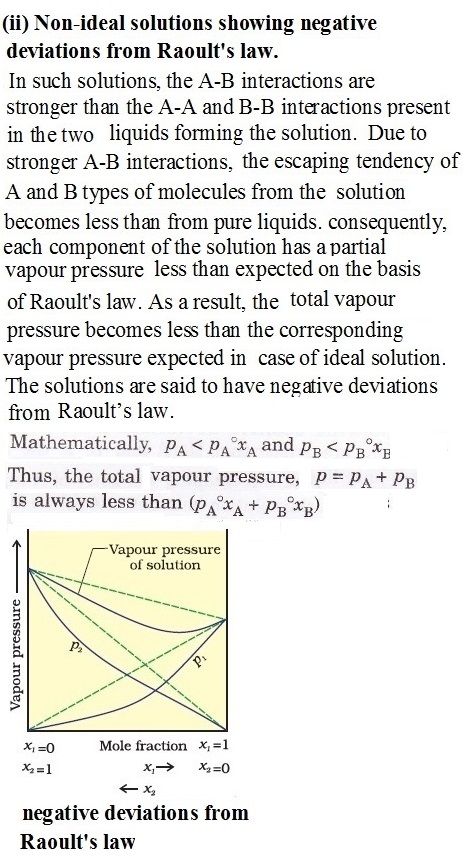
1. Negative deviation from Raoult's law occurs when:
A. A–B interactions are weaker than A—A and B—B
B. A–B interactions are stronger than A—A and B—B
C. All intermolecular forces are equal
D. No intermolecular forces exist
2. In negative deviation from Raoult's law, the escaping tendency of molecules:
A. Increases
B. Decreases
C. Remains constant
D. Becomes infinite
3. In case of negative deviation, the total vapour pressure of the solution is:
A. Greater than predicted by Raoult's law
B. Equal to Raoult's law prediction
C. Less than predicted by Raoult's law
D. Zero
4. In negative deviation, the partial vapour pressure of each component is:
A. Greater than expected
B. Equal to expected
C. Less than expected
D. Zero
5. The strong A—B interactions in negative deviation cause molecules to:
A. Escape easily into vapour phase
B. Remain more strongly held in solution
C. Break completely
D. Become ions
6. When A–B forces are stronger than A—A and B—B forces, the solution shows:
A. Positive deviation
B. Negative deviation
C. Ideal behaviour
D. No deviation
7. In negative deviation, the intermolecular attraction in the solution is:
A. Weaker than pure liquids
B. Stronger than pure liquids
C. Equal to pure liquids
D. Absent
8. Negative deviation indicates that:
A. Molecules are loosely held
B. Intermolecular forces are weaker
C. Intermolecular forces are stronger
D. Vapour pressure increases
9. In negative deviation from Raoult's law:
A. Vapour pressure increases
B. Vapour pressure decreases
C. Vapour pressure remains constant
D. Vapour pressure becomes infinite