MCQs
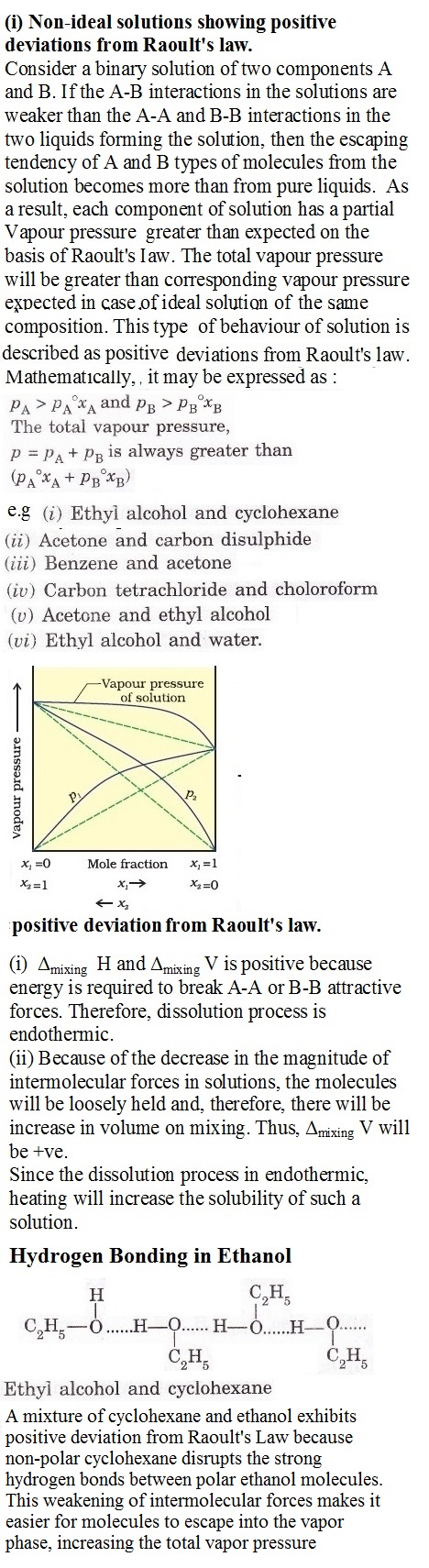
1. Positive deviation from Raoult's law occurs when:
A. A‐B interactions are stronger than A‐A and B‐B
B. A‐B interactions are weaker than A‐A and B‐B
C. All intermolecular forces are equal
D. No intermolecular forces exist
2. In positive deviation from Raoult's law, the escaping tendency of molecules :
A. Decreases
B. Remains constant
C. Increases
D. Becomes zero
3. In case of positive deviation, the total vapour pressure of the solution is:
A. Less than predicted by Raoult's law
B. Equal to Raoult's law prediction
C. Greater than predicted by Raoult's law
D. Zero
4. For positive deviation, the enthalpy of mixing ΔSmixing is:
A. Negative
B. Zero
C. Positive
D. Infinite
5. In positive deviation, the volume change on mixing (ΔVmixing) is generally:
A. Negative
B. Zero
C. Positive
D. Infinite
6. Which pair of liquids shows positive deviation from Raoult's law?
A. Water and nitric acid
B. Ethyl alcohol and cyclohexane
C. Benzene and toluene
D. Acetone and chloroform
7. A mixture of ethanol and cyclohexane shows positive deviation because:
A. Strong hydrogen bonding forms between molecules
B. Cyclohexane breaks hydrogen bonding in ethanol
C. Molecules become heavier
D. Vapour pressure becomes zero
8. In positive deviation, the dissolution process is generally:
A. Exothermic
B. Endothermic
C. Isothermal
D. Adiabatic
9. Which of the following pairs shows positive deviation from Raoult's law?
A. Acetone and carbon disulphide
B. Water and hydrochloric acid
C. Nitric acid and water
D. Acetone and chloroform
10. When intermolecular forces decrease in a solution:
A. Molecules are tightly held
B. Molecules escape more easily into vapour phase
C. Vapour pressure becomes zero
D. Volume decreases