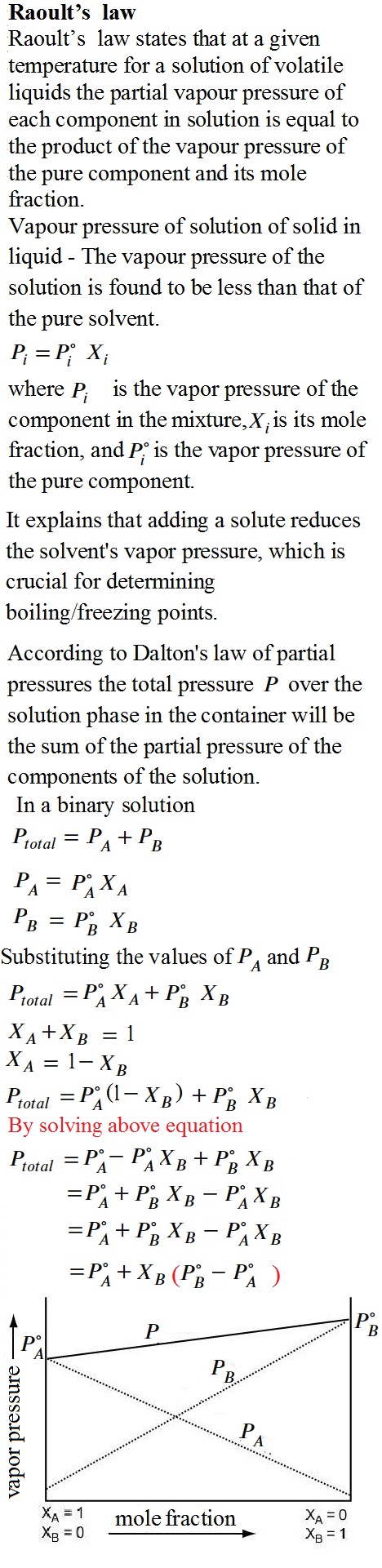
MCQs
1. Raoult's law states that the partial vapour pressure of each component in a solution is equal to:
A. Product of mole fraction and vapour pressure of pure component
B. Sum of mole fraction and vapour pressure
C. Difference of mole fraction and vapour pressure
D. Ratio of mole fraction and vapour pressure
2. When a non-volatile solute is added to a solvent, the vapour pressure of the solvent:
A. Increases
B. Decreases
C. Remains constant
D. Becomes zero
3. The lowering of vapour pressure on adding a solute is the basis of:
A. Colligative properties
B. Nuclear reactions
C. Electrolysis
D. Adsorption
4. According to Dalton's law, the total vapour pressure of a binary solution is:
A. Difference of partial pressures
B. Product of partial pressures
C. Sum of partial pressures
D. Average of partial pressures
5. In an ideal binary solution obeying Raoult's law:
A. Only solute contributes to vapour pressure
B. Only solvent contributes to vapour pressure
C. Both components contribute to vapour pressure
D. No component contributes
6. Vapour pressure of a solution containing a solid solute in a liquid solvent is:
A. Greater than pure solvent
B. Equal to pure solvent
C. Less than pure solvent
D. Independent of solvent
1. What is a non-volatile solute?
A non-volatile solute is a substance that does not vaporize (evaporate) easily and has negligible vapour pressure at a given temperature.
In other words, when it is dissolved in a solvent, only the solvent contributes to the vapour pressure of the solution, while the solute remains in the liquid phase.
Examples:
Sodium chloride (NaCl) in water
Sucrose (sugar) in water
Glucose in water