Assignment 10
Calculate moles
1.
Find the number of moles in 22 g of CO2.
2.
How many molecules are present in 1 mole of H2O?
3.
Find moles in 10 g of NaCl.
4.
How many grams are present in 2 moles of O2?
5.
Find the number of atoms in 0.25 mol of carbon.
6.
Find the number of moles in 4.01 x 10²³ molecules of NH3.
7.
What is the mass of 1.5 x 10²³ molecules of CO2?
Assignment 11
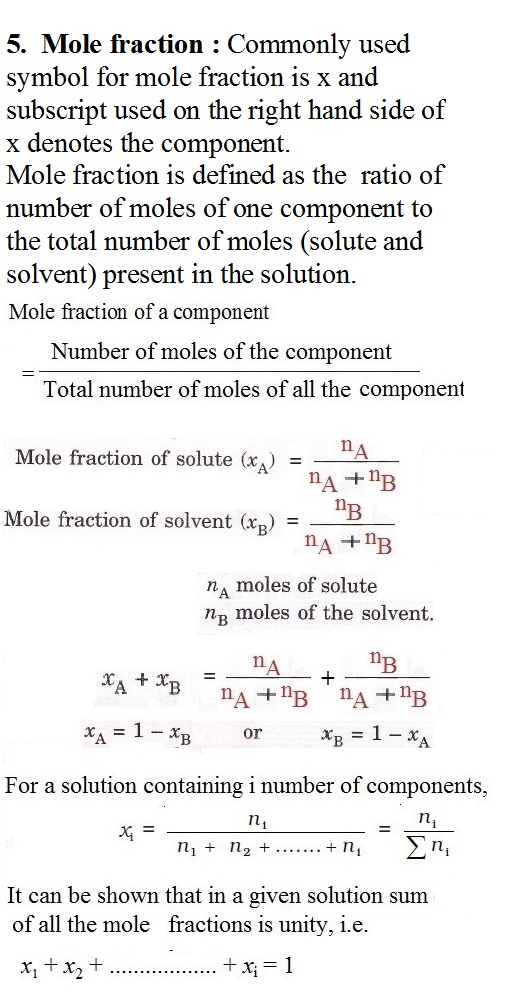
1. 2 moles of A and 3 moles of B are mixed. Find mole fraction of A.
2. 1 mole of ethanol + 4 moles of water. Find mole fraction of ethanol.
3. 3 moles of gas A and 1 mole of gas B. Find mole fraction of B.
4. 5 g NaCl (M = 58.5 g/mol) dissolved in 100 g water (M = 18 g/mol). Find mole fraction of NaCl.
5. 10 g glucose (M = 180 g/mol) dissolved in 90 g water. Find mole fraction of glucose.
6. 2 moles of CO2 and 3 moles of O2 are mixed. Find mole fraction of each gas.
7. Equal masses of O2 (M = 32) and NO2 (M = 46) are mixed. Find mole fraction of O2 .
8. A solution contains 46 g ethanol (M = 46) and 54 g water (M = 18). Find mole fraction of ethanol.
9. If mole fraction of solute = 0.2, find mole fraction of solvent.
assignment 12
MCQs
1. A solution contains 2 moles of A and 3 moles of B. The mole fraction of A is:
A) 0.2
B) 0.4
C) 0.6
D) 0.8
2. Equal masses of methane (CH4) and oxygen (O2)) are mixed. Mole fraction of methane is:
(Molar mass: CH4) = 16, O2) = 32)
A) 0.25
B) 0.33
C) 0.50
D) 0.67
3. The mole fraction of solute in a dilute solution is 0.01. The mole fraction of solvent is:
A) 0.01
B) 0.99
C) 1.01
D) 0.5
4. 10 g urea (M = 60 g/mol) is dissolved in 90 g water. Mole fraction of urea is:
A) 0.03
B) 0.032
C) 0.02
D) 0.01
5. If mole fraction of A is 0.4, then mole fraction of B is:
A) 0.6
B) 0.4
C) 1
D) 0
6. A solution contains 18 g glucose (M = 180) in 180 g water. Mole fraction of glucose is:
A) 0.01
B) 0.02
C) 0.1
D) 0.5
7. Equal number of moles of two gases are mixed. Mole fraction of each gas is:
A) 1
B) 0.5
C) 0.25
D) Depends on mass
8. Mole fraction is independent of:
A) Temperature
B) Pressure
C) Amount of substance
D) Nature of substance
Assignment 13
Assertion
Reason
Q1.
Assertion (A): Mole fraction is a dimensionless quantity.
Reason (R): It is the ratio of moles of a component to total moles.
A) Both A and R are true, and R is correct explanation
B) Both A and R are true, but R is not correct explanation
C) A is true, R is false
D) A is false, R is true
Q2.
Assertion (A): Sum of mole fractions in a solution is always 1.
Reason (R): Mole fraction depends on temperature.
Q3.
Assertion (A): Mole fraction is independent of temperature and pressure.
Reason (R): It depends only on number of moles.
Q4.
Assertion (A): In a binary solution, if mole fraction of solute is 0.3, solvent is 0.7.
Reason (R): Sum of mole fractions is unity.
Q5.
Assertion (A): Equal masses of different gases have equal mole fractions.
Reason (R): Mole fraction depends on molar mass.
Q6.
Assertion (A): Mole fraction of a component increases with increase in its moles.
Reason (R): Mole fraction is directly proportional to moles of that component.
Q7.
Assertion (A): Mole fraction can be used for gases and solutions both.
Reason (R): It is based on number of moles.
Q8.
Assertion (A): Mole fraction of solute in a dilute solution is very small.
Reason (R): Number of moles of solute is very less compared to solvent.
Assignment 14
Test
Q1.
Mole fraction of A if 1 mole A + 4 moles B:
A) 0.1
B) 0.2
C) 0.25
D) 0.5
Q2.
Sum of mole fractions in a solution is:
Q3.
Equal moles of two gases → mole fraction of each:
A) 1
B) 0.5
C) 0.25
D) Depends on mass
Q4.
10 g NaCl (58.5 g/mol) in 100 g water → mole fraction of NaCl approx:
A) 0.03
B) 0.02
C) 0.01
D) 0.2
Q5.
Mole fraction is independent of:
A) Moles
B) Temperature
C) Composition
D) Amount
Q6.
If XA =0.7XA = 0.7XA =0.7, then XB =?
A) 0.3
B) 0.7
C) 1
D) 0
Q7.
Equal masses of H2 (2 g/mol) and O2 (32 g/mol). Mole fraction of H2 is:
A) 0.94
B) 0.5
C) 0.25
D) 0.75
Q8.
Mole fraction is a:
A) Unit
B) Dimensionless quantity
C) Mass
D) Volume
Q9.
If mole fraction of solute = 0.05, solvent = ?
A) 0.95
B) 1.05
C) 0.5
D) 0.05
Q10.
Which increases mole fraction of solute?
A) Decreasing its moles
B) Increasing solvent
C) Increasing solute
D) Increasing temperature
Assignment 15
N1.1. Calculate the mass percentage of benzene (C6H6) and carbontetrachloride (CCl4) if 44 g of benzene is dissolved in 61 g of carbon tetrachloride.
N2.1. Calculate the mole fraction of benzene in solution containing 20% by mass in carbon tetrachloride.
N3.1. Calculate the molarity of each of the following solutions: (a) 20 g of Co(NO3)2. 6H2O in 8.6 L of solution (b) 30 mL of 0.2 M H2SO4 diluted to 500 mL.
N4.1. Calculate the mass of urea (NH2CONH2) required in making 3.5 kg of 0.35 molal aqueous solution.
N5.1. Calculate (a) molality (b) molarity and (c) mole fraction of KI if the density of 30% (mass/mass) aqueous KI is 1.202 g mL-1.
N5.1.
Conversion Mass‐Volume (Volume=Density / Mass) Or ( m=d✕V);m = mass, d = density, V = volume
a. Find the volume of 20 g of ethanol. Density of ethanol = 0.789 g/mL (V=25.34mL)
b. Find the volume of 50 g of water.
Density of water = 1 g/mL V=50mL
c. Density of benzene = 0.88 g/mL.
Find the volume of 44 g benzene. V=50mL
d. Find the mass of 25 mL ethanol.
Density of ethanol = 0.789 g/mL
e. Find the mass of 100 mL water.
Density of water = 1 g/mL
f. Density of benzene = 0.88 g/mL.
Find mass of 50 mL benzene.
Assignment 16
E1. Calculate the mole fraction of ethylene glycol (C2H6O2) in a solution containing 20% of (C2H6O2) by mass.
E2. Calculate the molarity of a solution containing 5 g of NaOH in 450 mL solution.
E3. Calculate molality of 2.5 g of ethanoic acid (CH3COOH) in 75 g of benzene.
N1. Calculate the mass percentage of benzene (C6H6) and carbontetrachloride (CCl4) if 22 g of benzene is dissolved in 122 g of carbon tetrachloride.
N2. Calculate the mole fraction of benzene in solution containing 30% by mass in carbon tetrachloride.
N3. Calculate the molarity of each of the following solutions: (a) 30 g of Co(NO3)2. 6H2O in 4.3 L of solution (b) 30 mL of 0.5 M H2SO4 diluted to 500 mL.
Key Words ‐
pure_substances