MCQs
1. Molality depends on:
A. Temperature
B. Pressure
C. Mass of solvent
D. Volume of solution
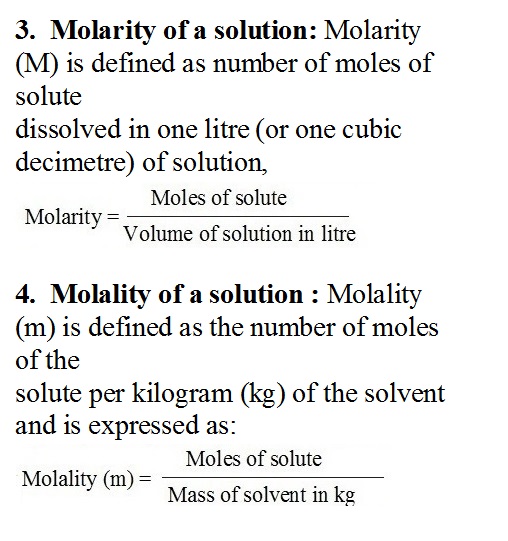
Explanation: Molality is based on kg of solvent, so it is independent of temperature and pressure.
2. Which concentration unit is temperature independent?
A) Molarity
B) Normality
C) Molality
D) Mole fraction
C) Molality
Explanation: Volume changes with temperature, but mass doesn’t →molality stays constant.
3. Molality of a solution containing 10 g NaCl (M = 58.5 g/mol) in 100 g water is:
A) 1.71 m
B) 0.171 m
C) 17.1 m
D) 0.0171 m
A
Moles = 10 / 58.5 ≈ 0.171
Mass = 0.1 kg
m = 0.171 / 0.1 = 1.71 m
4. If 1 mole of solute is dissolved in 1 kg solvent, molality is:
A) 0.5 m
B) 1 m
C) 2 m
D) 10 m
B) 1 m
5. Which change will NOT affect molality?
A) Adding more solvent
B) Increasing temperature
C) Adding more solute
D) Removing solvent
B) Increasing temperature
Explanation: Molality depends only on moles and mass, not temperature.
6. A solution is prepared by dissolving 1 mole solute in 1 kg water. If water evaporates and becomes 500 g, new molality is:
A) 1 m
B) 2 m
C) 0.5 m
D) 4 m
Mass = 0.5 kg
m = 1 / 0.5 = 2 m
Answer: B) 2 m
7. Molality of 9.8 g H2SO4 (M = 98 g/mol) in 100 g water is:
A) 0.1 m
B) 1 m
C) 0.01 m
D) 10 m
Moles = 9.8 / 98 = 0.1
Mass = 0.1 kg
m = 0.1 / 0.1 = 1 m
B) 1 m
8. Which statement is correct?
A) Molality depends on volume
B) Molality changes with temperature
C) Molality uses mass of solvent
D) Molality is same as molarity
Answer: C) Molality uses mass of solvent
9. 1 mole of solute is dissolved in 1 L solution. Density = 1 g/mL. Find molality.
Solution:
Mass of solution = 1000 g
Mass of solvent ≈ 1000 − molar mass (assume negligible solute for basic) ≈ 1000 g = 1 kg
m ≈ 1 / 1 = 1 m
‐ If density = 1 g/mL → M ≈ m (dilute solution)
10. 1 M NaCl solution (density = 1.2 g/mL). Find molality.
Solution:
Volume = 1 L → mass = 1200 g
Moles = 1
Mass of solvent = 1200 − 58.5 = 1141.5 g = 1.1415 kg
m = 1 / 1.1415 = 0.876 m
11. 2 m solution of urea (M = 60 g/mol). Find molarity (density = 1.1 g/mL).
Solution:
Assume 1 kg solvent
Moles = 2
Mass of solution = 1000 + (2 × 60) = 1120 g
Volume = 1120 / 1.1 = 1018 mL = 1.018 L
M = 2 / 1.018 = 1.97 M
12. 0.5 M solution, density = 1 g/mL. Find molality.
Solution:
1 L solution → 1000 g
Moles = 0.5
Mass of solvent ≈ 1000 g = 1 kg
m ≈ 0.5 / 1 = 0.5 m