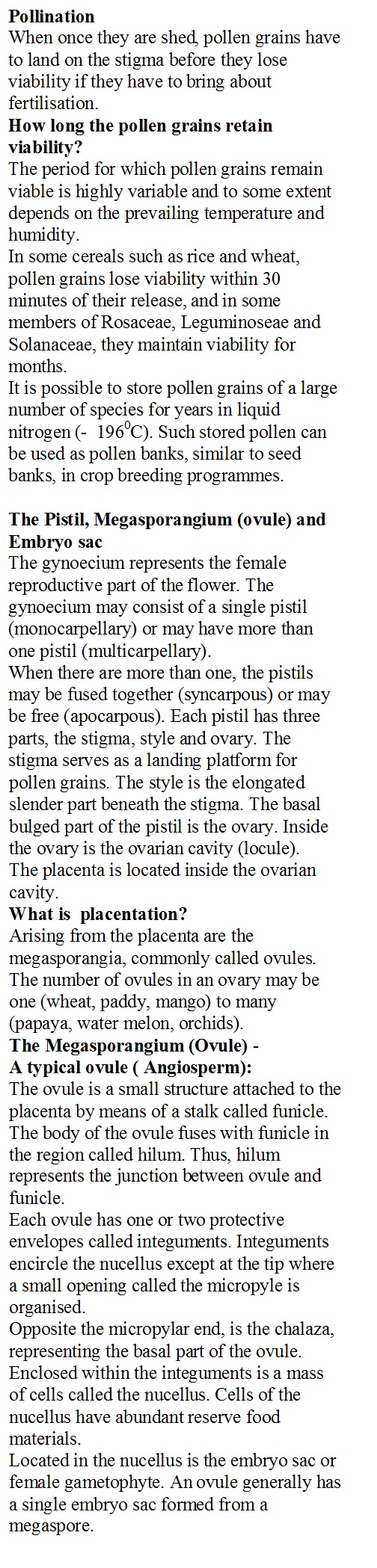
MCQs
1. Pollen grains must reach the stigma before they lose
A. Fertility
B. Viability
C. Germination
D. Growth
2. In cereals like rice and wheat, pollen grains lose viability within about
A. 10 minutes
B. 30 minutes
C. 2 hours
D. 24 hours
3. Pollen grains of some members of Rosaceae, Leguminoseae and Solanaceae remain viable for
A. Minutes
B. Hours
C. Days
D. Months
4. Pollen grains can be stored for years in
A. Freezer (0°C)
B. Ice (0°C)
C. Liquid nitrogen (‐196°C)
D. Dry ice (‐78°C)
5. Stored pollen grains used in breeding programmes are called
A. Seed banks
B. Pollen banks
C. Gene banks
D. DNA banks
6. The female reproductive part of a flower is called
A. Androecium
B. Gynoecium
C. Corolla
D. Calyx
7. A gynoecium with a single pistil is called
A. Syncarpous
B. Apocarpous
C. Monocarpellary
D. Polycarpellary
8. When two or more pistils are fused together, the condition is called
A. Apocarpous
B. Syncarpous
C. Monocarpellary
D. Unicarpellary
9. The part of pistil that receives pollen grains is
A. Style
B. Ovary
C. Stigma
D. Placenta
10. The elongated slender part of the pistil below the stigma is
A. Ovule
B. Style
C. Placenta
D. Funicle
11. The swollen basal part of the pistil is
A. Ovary
B. Stigma
C. Style
D. Nucellus
12. The arrangement of ovules on the placenta inside the ovary is called
A. Pollination
B. Fertilisation
C. Placentation
D. Germination
13. The stalk attaching the ovule to the placenta is called
A. Hilum
B. Funicle
C. Chalaza
D. Micropyle
14. The junction between ovule and funicle is called
A. Micropyle
B. Chalaza
C. Hilum
D. Placenta
15. The small opening in the integuments of the ovule is called
A. Chalaza
B. Micropyle
C. Hilum
D. Nucellus
16. The basal part of the ovule opposite the micropyle is called
A. Hilum
B. Chalaza
C. Placenta
D. Style
17. The tissue inside the integuments that contains reserve food material is
A. Nucellus
B. Endosperm
C. Cotyledon
D. Embryo
18. The female gametophyte in angiosperms is called
A. Ovule
B. Embryo sac
C. Endosperm
D. Megaspore
19. Usually an ovule contains
A. Many embryo sacs
B. Two embryo sacs
C. One embryo sac
D. No embryo sac
20. Ovules arise from
A. Style
B. Placenta
C. Stigma
D. Petal
Q. What is dry ice?
Dry ice is the solid form of carbon dioxide (CO 2).
It is called “dry ice” because it changes directly from solid to gas without becoming liquid.
This process is called sublimation.
Temperature of dry ice is about ‐78.5°C.
Uses:
a. Preserving food during transport
b. Creating fog effects in stage shows
c. Scientific experiments and cooling materials
Liquid nitrogen is the liquid form of nitrogen (N2).
Temperature: ‐196°C,
It is used to store pollen grains, seeds, and biological samples for a long time Storage of pollen in liquid nitrogen is called cryopreservation.
Draw the following
1. Monocarpous, syncarpous and apocarpous ovary
2. Ovules
3. Embryo sac
One-word answer questions ‐
1. Landing platform for pollen grains.
2. Female reproductive part of a flower.
3. Gynoecium with a single pistil.
4. Condition where pistils are fused together.
5. Condition where pistils are free.
6. Arrangement of ovules in the ovary.
7. Stalk attaching ovule to placenta.
8. Junction between ovule and funicle.
9. Small opening at the tip of ovule.
10. Basal part of ovule opposite to micropyle.
11. Tissue inside integuments containing reserve food.
12. Female gametophyte in angiosperms.
13. Cavity inside the ovary.
For NEET ‐ Biology and Chemistry;
Join‐ Success Vector Pvt Ltd; Contact ‐Mob. 9357388588