MCQs
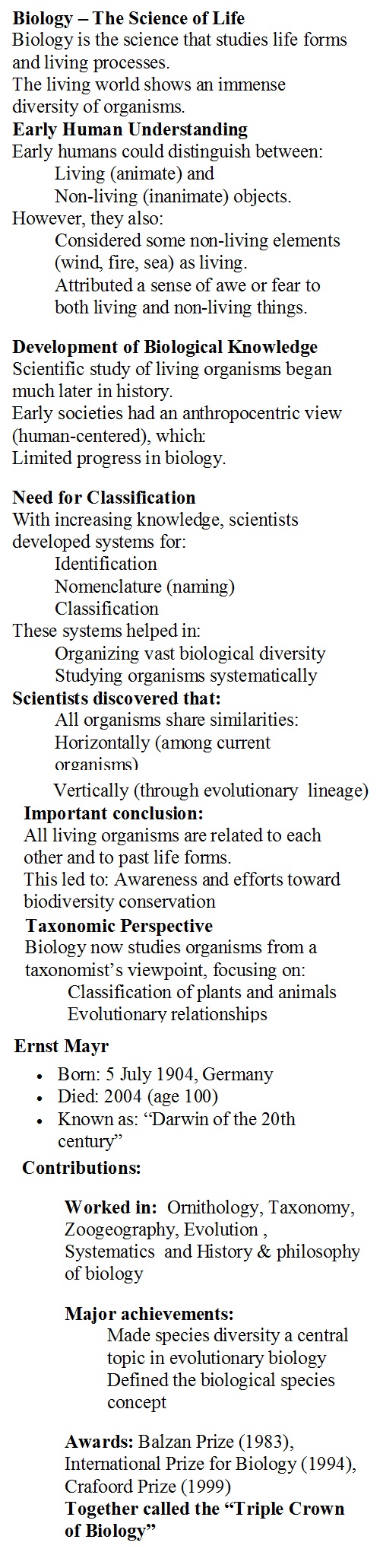
1. Biology is the science that deals with:
A. Non-living matter
B. Living organisms and life processes
C. Chemical reactions only
D. Physical laws
2. The living world is known for its:
A. Uniformity
B. Simplicity
C. Diversity
D. Stability
3. Early humans classified objects into:
A. Plants and animals
B. Useful and harmful
C. Living and non-living
D. Visible and invisible
4. Early humans considered which of the following as living?
A. Trees
B. Animals
C. Fire and wind
D. Bacteria
5. Scientific study of living organisms began:
A. In ancient times fully developed
B. Recently compared to human history
C. During prehistoric times
D. At the origin of Earth
6. Early societies had an anthropocentric view, meaning:
A. Nature-centered
B. Animal-centered
C. Human-centered
D. God-centered
7. Anthropocentric thinking resulted in:
A. Rapid biological discoveries
B. Limited progress in biology
C. Advanced classification
D. Development of evolution theory
8. Which of the following is NOT a component of classification systems?
A. Identification
B. Nomenclature
C. Digestion
D. Classification
9. Nomenclature refers to:
A. Identifying organisms
B. Naming organisms
C. Grouping organisms
D. Studying evolution
10. Classification helps in
A. Increasing confusion
B. Destroying biodiversity
C. Organizing biological diversity
D. Eliminating species
11. Horizontal similarities refer to similarities:
A. Between past and present organisms
B. Among organisms living at the same time
C. Only in plants
D. Only in animals
12. Vertical similarities refer to similarities:
A. Among unrelated organisms
B. Through evolutionary lineage
C. Between plants only
D. Between animals only
13. A major conclusion of biological studies is:
A. Organisms are unrelated
B. Only plants are related
C. All organisms are interrelated
D. Only animals evolved
14. Taxonomy mainly deals with:
A. Chemical reactions
B. Classification of organisms
C. Physics laws
D. Astronomy
15. Modern biology studies organisms from a:
A. Religious viewpoint
B. Taxonomic viewpoint
C. Economic viewpoint
D. Artistic viewpoint
16. Ernst Mayr is known as:
A. Father of Genetics
B. Darwin of the 20th century
C. Father of Botany
D. Father of Microbiology
17. Ernst Mayr worked in all EXCEPT:
A. Ornithology
B. Evolution
C. Thermodynamics
D. Taxonomy
18. Ernst Mayr is famous for defining:
A. Cell theory
B. Biological species concept
C. Law of inheritance
D. Theory of relativity
19. The ‐Triple Crown of Biology‐ includes which awards?
A. Nobel Prize only
B. Balzan, International Biology Prize, Crafoord Prize
C. Oscar Awards
D. Booker Prize
20. The study of distribution of animals is called:
A. Botany
B. Zoogeography
C. Ecology
D. Anatomy