
 ">
">
Help →Chemical Kinetics
Fill in the blanks
1. Chemical kinetics deals with the __________ of chemical reactions.
2. The word 'kinetics' means __________.
3. Chemical kinetics studies reaction __________ and mechanism.
4. Feasibility of a reaction is predicted by __________.
5. A reaction is spontaneous when ΔG is __________ than zero.
6. The extent of reaction is determined by __________.
7. The speed of a chemical reaction is studied in __________.
8. Chemical kinetics tells how __________ a reaction occurs.
9. Thermodynamics predicts the __________ of a reaction.
10. Diamond converts into graphite very __________.
11. Reaction rate means the __________ of a chemical reaction.
12. Reaction rate is affected by concentration, temperature, and __________.
13. Increasing concentration generally __________ the reaction rate.
14. Increasing temperature usually __________ the reaction rate.
15. Pressure mainly affects __________ reactions.
16. Study of reaction mechanism is a part of chemical __________.
17. Collision theory states that reactions occur through collisions of __________.
18. Effective collisions require sufficient energy and proper __________.
19. Instantaneous rate is measured at a particular __________.
20. Average rate is calculated over a time __________.
Short QA
1. What is chemical kinetics?
2. What does thermodynamics tell about a reaction?
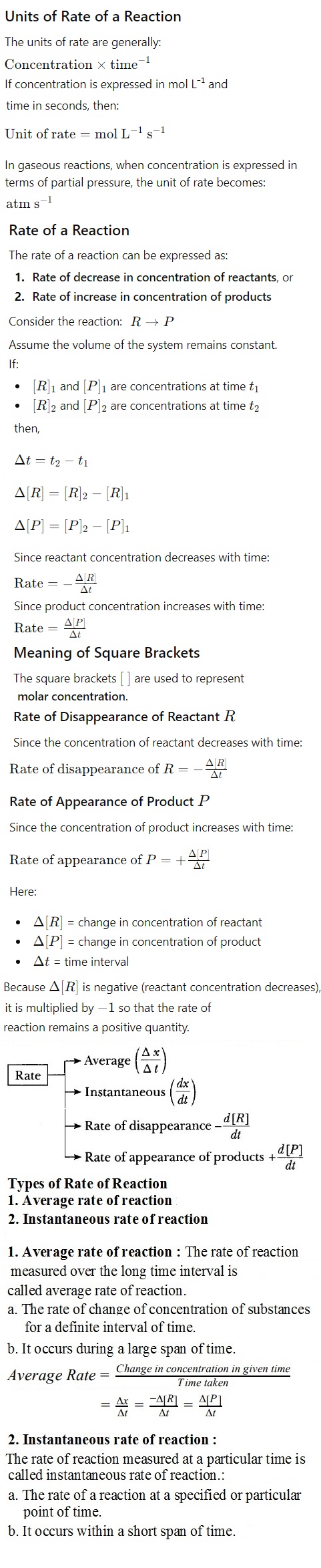
3. What is meant by rate of reaction?
4. Name any two factors affecting reaction rate.
5. What is the effect of temperature on reaction rate?
6. What is the role of a catalyst in a reaction?
7. What is collision theory?
8. What are effective collisions?
9. Differentiate between thermodynamics and chemical kinetics.
10. Why does diamond convert into graphite very slowly?
MCQs
1. Chemical kinetics deals with:
A) Structure of atoms
B) Rate of chemical reactions
C) Equilibrium only
D) Extraction of metals
2. The word 'kinetics' is derived from Greek word meaning:
A) Energy
B) Movement
C) Matter
D) Change
3. Chemical kinetics studies:
A) Reaction rates
B) Reaction mechanisms
C) Factors affecting rates
D) All of these
4. Feasibility of a reaction is predicted by:
A) Chemical kinetics
B) Thermodynamics
C) Electrochemistry
D) Surface chemistry
5. A reaction is feasible when:
A) ΔG > 0
B) ΔG = 0
C) ΔG < 0
D) ΔG = 1
6. Extent of reaction is determined by:
A) Thermodynamics
B) Chemical equilibrium
C) Spectroscopy
D) Electrolysis
7. Speed of reaction is studied in:
A) Organic chemistry
B) Chemical kinetics
C) Coordination chemistry
D) Nuclear chemistry
8. Chemical kinetics tells:
A) Whether reaction occurs
B) How fast reaction occurs
C) Colour of products
D) Shape of molecules
9. Thermodynamics tells:
A) Rate of reaction
B) Feasibility of reaction
C) Mechanism only
D) Catalyst action only
10. Diamond converts to graphite:
A) Rapidly
B) Instantly
C) Very slowly
D) Explosively
11. Rate of reaction means:
A) Amount of catalyst used
B) Speed of chemical reaction
C) Molecular mass
D) Heat evolved
12. Which affects reaction rate?
A) Concentration
B) Temperature
C) Catalyst
D) All of these
13. Increasing concentration generally:
A) Decreases rate
B) Increases rate
C) Stops reaction
D) No effect
14. Increasing temperature generally:
A) Slows reaction
B) Increases reaction rate
C) Stops collisions
D) Decreases energy
15. Pressure mainly affects:
A) Solid reactions
B) Liquid reactions
C) Gaseous reactions
D) Nuclear reactions
16. Catalyst generally:
A) Decreases rate
B) Increases rate
C) Stops reaction
D) Changes equilibrium constant always
17. Study of reaction mechanism is part of:
A) Chemical kinetics
B) Thermodynamics
C) Qualitative analysis
D) Metallurgy
18. At macroscopic level, we study:
A) Molecular collisions
B) Amount reacted or formed
C) Electron spin
D) Atomic radius
19. At molecular level, kinetics studies:
A) Crystal defects
B) Orientation of molecules
C) Magnetic moment
D) Atomic number
20. Collision theory states reactions occur through:
A) Heating only
B) Collisions of molecules
C) Electrolysis only
D) Diffusion only
21. Effective collision requires:
A) Proper orientation
B) Sufficient energy
C) Both A and B
D) Low temperature on