Human Reproduction Module-1 Male Reproductive System Module‐1
Fill in the blanks
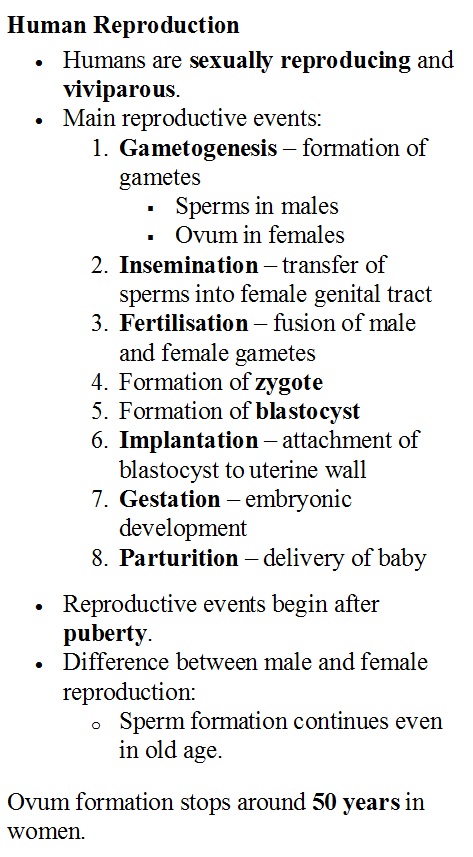
1. Humans are sexually reproducing and __________.
2. Formation of gametes is called __________.
3. Male gametes are called __________.
4. Female gametes are called __________.
5. Transfer of sperms into female genital tract is called __________.
6. Fusion of male and female gametes is called __________.
7. The fertilized egg formed after fusion is called __________.
8. Attachment of blastocyst to uterine wall is called __________.
9. Development of embryo inside uterus is called __________.
10. Delivery of baby is called __________.
11. Reproductive events begin after __________.
12. Sperm formation continues even in __________ age.
13. Ovum formation stops around the age of __________ years in women.
14. Male reproductive system is located in the __________ region.
15. Testes are situated outside the abdominal cavity in a pouch called __________.
16. Scrotum maintains temperature about __________ lower than body temperature.
17. Lower temperature is necessary for __________.
18. Each testis contains about __________ testicular lobules.
19. Seminiferous tubules are the site of __________ production.
20. Male germ cells are called __________.
21. Spermatogonia undergo __________ to form sperms.
22. __________ cells provide nourishment to germ cells.
23. Interstitial cells are also called __________ cells.
24. Leydig cells secrete male hormones called __________.
25. An example of androgen is __________.
26. Sequence of ducts begins with __________ tubules.
27. Sperms mature and are stored in the __________.
28. Vas deferens loops over the urinary __________.
29. Urethra opens outside through the urethral __________.
30. Penis contains __________ tissue for insemination.
31. Enlarged tip of penis is called __________ penis.
32. Loose skin covering glans penis is called __________.
33. Seminal vesicles secrete seminal fluid rich in __________.
34. Fructose provides __________ for sperm movement.
35. Seminal vesicles contribute major volume of __________.
36. Prostate gland secretes thin, milky __________ fluid.
37. Prostate gland improves sperm __________.
38. Bulbourethral glands are also called __________ glands.
39. Bulbourethral glands secrete clear __________-like fluid.
40. Bulbourethral glands help in smooth passage of __________ during ejaculation.
Short QAs
1. What are the main reproductive events in humans?
2. Why are humans called viviparous?
3. What is the difference between sperm formation and ovum formation in humans?
4. Name the main parts of the male reproductive system.
5. Why are testes located in the scrotum?
6. What is the function of scrotum?
7. What is spermatogenesis?
8. What are seminiferous tubules? Mention their function.
9. What are spermatogonia?
10. What is the function of Sertoli cells?
11. What are Leydig cells? State their function.
12. Name the male hormone secreted by Leydig cells.
13. Write the sequence of male accessory ducts.
14. What is the function of epididymis?
15. What is the function of vas deferens?
16. What is the function of urethra in males?
17. What is the role of penis in reproduction?
18. What is glans penis?
19. What is foreskin?
20. Name the male accessory glands.
21. Write the functions of seminal vesicles.
22. Write the functions of prostate gland.
23. Write the functions of bulbourethral glands.
24. Why is fructose present in seminal fluid?
25. Why is alkaline fluid added to semen?
MCQs
1. Humans are described as:
(a) Asexual and oviparous
(b) Sexual and viviparous
(c) Hermaphrodite
(d) External fertilizers
2. Formation of gametes is called:
(a) Fertilisation
(b) Implantation
(c) Gametogenesis
(d) Gestation
3. Fusion of male and female gametes leads to formation of:
(a) Embryo
(b) Blastocyst
(c) Zygote
(d) Placenta
4. Attachment of blastocyst to uterine wall is called:
(a) Fertilisation
(b) Implantation
(c) Parturition
(d) Insemination
5. The pouch in which testes are present is called:
(a) Epididymis
(b) Vas deferens
(c) Scrotum
(d) Urethra
6. Scrotum helps in maintaining temperature:
(a) Equal to body temperature
(b) Higher than body temperature
(c) 2‐2.5°C lower than body temperature
(d) 5°C lower than body temperature
7. Sperms are produced in:
(a) Leydig cells
(b) Seminiferous tubules
(c) Epididymis
(d) Vasa efferentia
8. Cells that provide nutrition to germ cells are:
(a) Leydig cells
(b) Spermatogonia
(c) Sertoli cells
(d) Interstitial cells
9. Testicular hormones (androgens) are secreted by:
(a) Sertoli cells
(b) Germ cells
(c) Leydig cells
(d) Epididymis
10. Seminal plasma is rich in:
(a) Glucose and proteins
(b) Fructose, calcium and enzymes
(c) Lipids and starch
(d) Vitamins only
Help →